Secret Garden Dreams: Create Your Private Outdoor Paradise With These Expert Techniques
A magnificent garden is one of the most deeply satisfying and long-lasting investments a homeowner can make. Unlike interior furnishings that date quickly, a well-designed garden improves with every passing year — maturing plants filling their allotted spaces, climbing roses reaching their full glory, and established trees creating the kind of dappled shade that takes decades to develop. This guide reveals exactly how to plan, plant, and cultivate your private outdoor paradise.
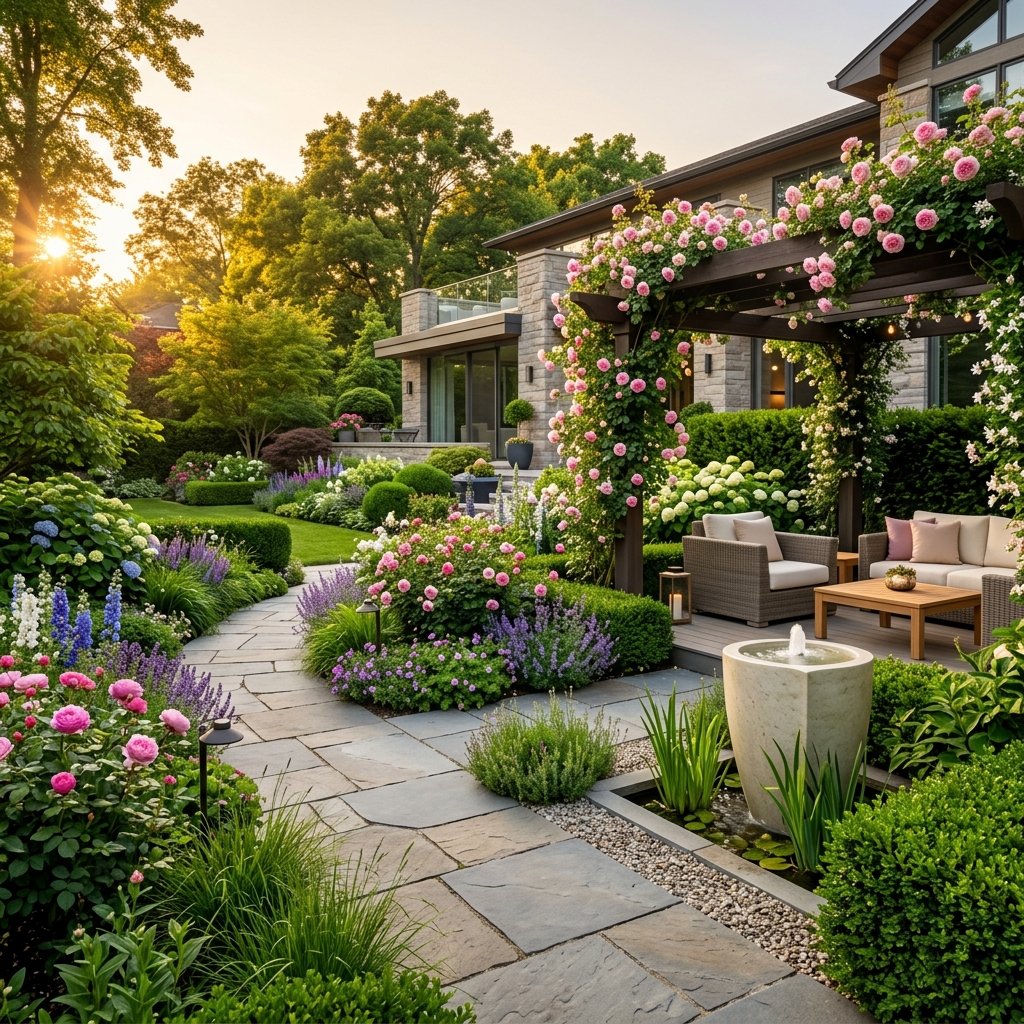
Table of Contents
The Garden as an Outdoor Room
The finest garden designers of our time — from Arabella Lennox-Boyd to Piet Oudolf to Dan Pearson — share a fundamental design philosophy: a great garden is not simply an outdoor space, but a series of outdoor rooms, each with its own character, purpose, and atmosphere. Just as a skilled interior designer sequences rooms to create a journey through a home, the great garden designer sequences spaces to create a journey through a landscape — from the arrival at the garden gate, through shaded woodland-like walkways, into sunny productive areas, and ultimately arriving at the garden's heart: the destination room that justifies the entire journey.
"A garden should be a place of discovery — somewhere you want to explore repeatedly because there is always something new to notice, some beauty you hadn't previously registered."
1. Structure: The Garden's Bones
In garden design, structure refers to the permanent elements that define the garden's form and character regardless of season — the paths that guide movement, the walls and hedges that create enclosure, the trees that provide vertical drama, and the built structures (pergolas, pavilions, summerhouses) that create destination points within the garden's landscape.
Paths and Paving
A garden without clearly defined pathways is a garden without direction — visitors will instinctively avoid walking across planted areas if they are not shown where to go. Stone paths in natural materials — limestone, sandstone, York stone — age beautifully and connect gardens to their regional material character. Gravel paths in crushed limestone or pea gravel are less expensive and allow free movement while providing a beautiful sound underfoot. The width of a primary garden path should be a minimum of 1.2 metres — wide enough for two people to walk comfortably side by side.
Hedges and Enclosure
Clipped hedges — yew, hornbeam, beech, box — create the garden rooms that define great garden design. They provide privacy, shelter from wind, and a lush, formal backdrop against which planting compositions can be read clearly. A yew hedge takes approximately 10-15 years to reach full height and density, but the investment in patience is repaid many times over in the extraordinary quality of the enclosure it eventually creates.
2. Water Features: Movement and Sound
Water has been central to great garden design for thousands of years — from the Islamic paradise gardens of Persia to the formal canal gardens of Le Nôtre to the naturalistic ponds of English Arts and Crafts garden designers. Its appeal is primordial: the sound of moving water is instinctively calming, its movement draws the eye, and its reflective surface creates a constantly changing mirror of sky, light, and surrounding planting.
In contemporary residential gardens, water features range from simple millstone fountains suitable for small urban courtyards to generous formal rectangular pools with underwater lighting and wall-mounted water jets. The key principle is scale — a water feature that is too small for its garden setting will look apologetic and tentative. Better to have no feature at all than one that is visually insignificant.
Natural swimming ponds — in which the swimming area and the biological filtration zone are combined in a single body of water, with aquatic plants purifying the water naturally — represent the most ambitious and beautiful water feature available to residential garden designers. Unlike conventional swimming pools, natural swimming ponds improve with age, developing their own ecosystem of frogs, dragonflies, and aquatic plants that create a genuinely extraordinary garden centrepiece.
3. The Planting Scheme: Year-Round Beauty
The most sophisticated garden planting schemes are designed to provide interest and beauty across all four seasons. This requires thinking beyond the obvious moments — the rose flush of June, the tulip display of April — to consider the winter structure provided by evergreen plants, the seed heads and dried stems of ornamental grasses in November, and the first snowdrops and hellebores of February that signal the turning year.
Climbing Roses: The Garden's Greatest Luxury
No plant transforms a garden with quite the combination of romance, fragrance, beauty, and generosity that a climbing rose provides. Trained across a generous pergola, up a house wall, or into a fruit tree, roses like 'Sander's White', 'New Dawn', 'Generous Gardener', and 'Mortimer Sackler' create a spectacle in June that no other plant can rival, and most offer reliable repeat-flowering throughout summer and into autumn.
4. Outdoor Rooms: Pergolas, Seating & Dining
The outdoor dining area has become as important as the indoor one in the finest residential gardens of 2026. A well-designed garden dining space — protected from direct midday sun by a pergola or overhead sail, furnished with weather-resistant furniture of genuine quality, and equipped with an outdoor kitchen or at minimum a serious barbecue — extends the usable living space of any home by several months each year.
The pergola structure is the key element. Built in hardwood, powder-coated steel, or weathered oak, a generous pergola (minimum 3m × 4m to seat eight comfortably) provides the structural framework from which climbing plants, pendant lights, and shade sails can be hung. Draped with wisteria, roses, and jasmine, a mature pergola creates a completely immersive outdoor experience of extraordinary beauty.
5. Garden Lighting for Evening Magic
Garden lighting transforms the outdoor space from a daytime feature into a fully inhabitable evening environment. The principles are similar to interior lighting design — layering ambient, accent, and decorative sources — but the scale and technical requirements are quite different.
Uplighting of established trees — directing low-wattage LED uplighters at the undersides of tree canopies — creates dramatic silhouettes and a theatrical quality that is simultaneously beautiful and practically useful for after-dark garden enjoyment. Path lighting, integrated low to the ground, guides movement safely without polluting the sky or creating glare. String lights woven through pergola structures and hedges create a festive warmth that makes outdoor dining in summer evenings an entirely magical experience.
Key Takeaways
- Design your garden as a series of interconnected outdoor rooms, each with its own purpose
- Invest in quality paved paths at least 1.2m wide to guide movement through the garden
- Install a water feature scaled generously to the garden — sound and movement transform any space
- Design for all four seasons — consider winter structure and early spring bulbs equally
- Build a generous pergola (minimum 3m × 4m) as the garden's social heart
- Layer garden lighting — uplight trees, edge-light paths, and string lights in pergola structures