The Ultimate 2026 Kitchen Design Guide: Marble, Gold & Smart Appliances That Transform Your Home's Heart
Today's kitchen is no longer simply a room for cooking. It is the social, architectural, and emotional centre of the modern home — a space that must balance extraordinary beauty with high-performance functionality. In this definitive guide, we reveal the materials, layouts, fixtures, and technologies that define the most coveted kitchens of 2026.
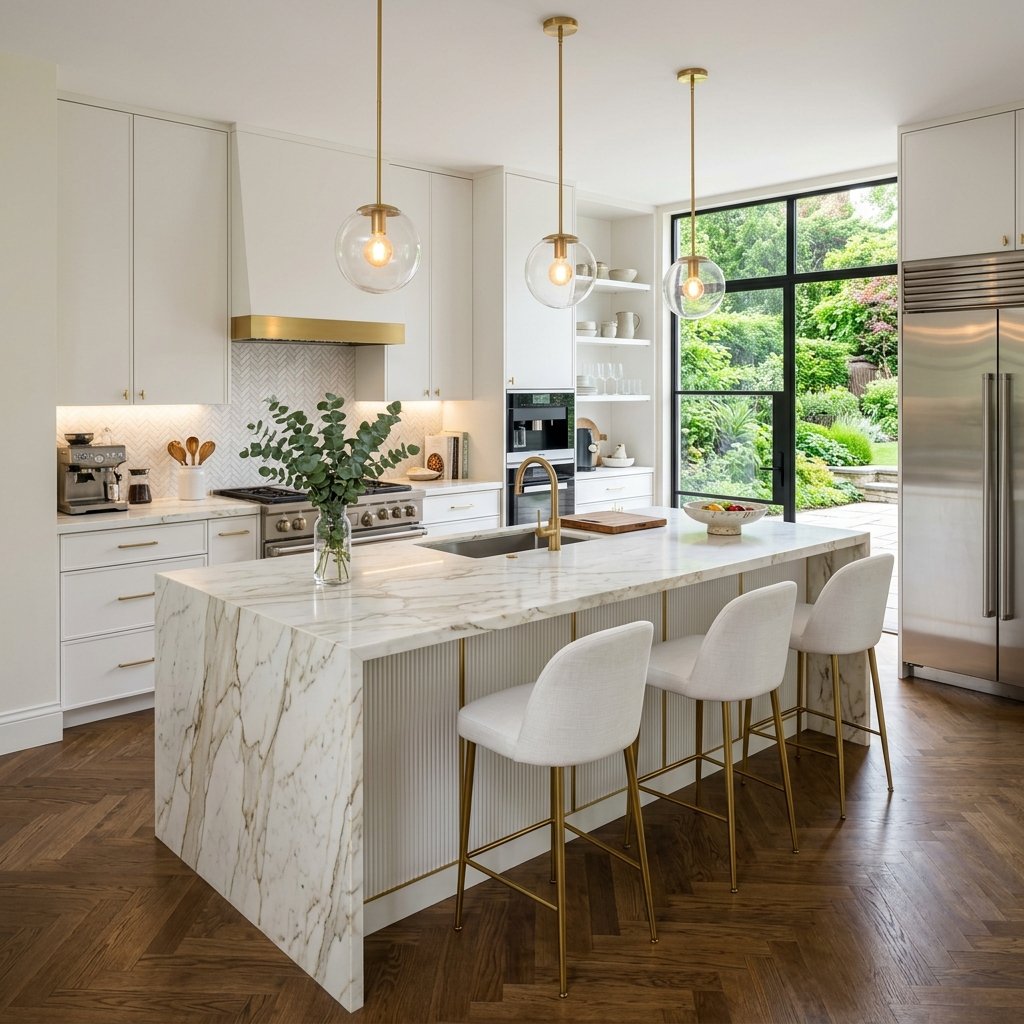
Table of Contents
- The Kitchen as the Home's Centrepiece
- 1. The Marble Island — Heart of Every Luxury Kitchen
- 2. Gold & Brass Fixtures: Warmth Meets Elegance
- 3. Smart Appliances: The Future is Already Here
- 4. Cabinetry Colours & Styles That Dominate 2026
- 5. Kitchen Lighting Design: Pendants, Recessed & More
- 6. Open-Plan Kitchen Layouts That Work
The Kitchen as the Home's Centrepiece
Walk into any newly constructed luxury home, and you will invariably find the kitchen positioned at its heart — physically, socially, and architecturally. This is not an accident. The world's leading residential architects and interior designers now treat the kitchen as the primary design statement of a home, the space around which all other rooms orient themselves.
In 2026, the kitchen has definitively shed its utilitarian past. Where once it was a room hidden behind closed doors, today's kitchen is deliberately open, visually connected to living and dining spaces, and designed with the same attention to material quality, lighting design, and aesthetic cohesion as the finest hotel lobbies. The result is a space that is simultaneously an efficient cooking environment, a social gathering place, and a work of residential architecture.
"The kitchen is no longer the hardest-working room in the house — it is the most beautiful. Design it as a destination, not a utility."
1. The Marble Island — Heart of Every Luxury Kitchen
The kitchen island has evolved from a practical preparation surface into the architectural centrepiece of the entire room. In the finest kitchens of 2026, the island is invariably clad in a premium natural stone — most coveted are the dramatic vein marbles that function almost as artworks in their own right.
Waterfall Islands: The Statement of the Decade
The waterfall island — where the countertop material continues vertically down the sides to the floor, creating an uninterrupted flow of stone — remains the single most requested kitchen design element in luxury residential projects. The effect is sculptural and visually stunning, transforming a functional surface into a dramatic centrepiece. Calacatta Viola, with its bold purple and gold veining on white marble, commands the highest interest in 2026, followed by the quieter grandeur of Calacatta Michelangelo and the warmer tones of Arabescato Corchia.
Sizing and Seating
In 2026, kitchen islands are generous in scale. The minimum length for a functional social island in a luxury kitchen is 2.4 metres, with high-end projects regularly specifying 3 to 4 metre islands that comfortably seat six. This scale shift reflects the island's dual role as both food preparation surface and social bar — the place where guests gather with a glass of wine while dinner is prepared, where children do homework, and where breakfast is served every morning.
2. Gold & Brass Fixtures: Warmth Meets Elegance
The stainless steel fixture that dominated kitchen design for three decades has been comprehensively dethroned. In its place, warm metallic finishes — particularly brushed gold, aged brass, and unlacquered brass — have become the defining hardware choice in luxury kitchen design. These metals bring a warmth and richness that stainless steel simply cannot provide, and they develop a beautiful patina over time that only enhances their character.
The key to using gold and brass successfully is restraint and consistency. Select a single metallic finish and apply it comprehensively throughout the kitchen — cabinet hardware, tap fittings, range hood details, light fixture frames, and accessories should all share the same metallic language. A scattered approach mixing chrome, brass, and stainless reads as unresolved; a fully committed brass palette reads as intentional and luxurious.
3. Smart Appliances: The Future is Already Here
Kitchen technology in 2026 has reached a level of sophistication that would have seemed extraordinary just five years ago. AI-powered ovens that recognise what you have placed inside and adjust cooking parameters automatically. Refrigerators with internal cameras that allow you to view contents remotely and suggest recipes based on available ingredients. Induction hobs that communicate with compatible cookware to maintain precise temperatures. Integrated dishwashers with soil sensors that adjust cycle intensity in real time.
Integration Over Spectacle
The most important design principle governing smart appliances in luxury kitchens is seamless integration. Refrigerators should be panel-ready, clad in the same cabinetry as surrounding storage so that they disappear into the overall composition. Hood ventilation should be incorporated into architectural ceiling volumes or disguised behind mirrored or stone panels. Coffee machines should be built into cabinetry at ergonomic heights. The technology should enhance life invisibly — present when needed, invisible when not.
4. Cabinetry Colours & Styles That Dominate 2026
The all-white kitchen — the defining aesthetic of the 2010s — has given way to a far richer, more characterful approach to cabinetry in 2026. Two-tone cabinetry schemes are particularly dominant: an upper cabinet colour that is lighter (often a warm off-white, pale sage green, or soft greige) paired with a distinctly darker lower cabinet (charcoal, navy, forest green, or deep burgundy). This creates visual interest and grounds the kitchen with a sense of anchored solidity.
Shaker-style doors remain the most enduring choice for their ability to work across both traditional and contemporary interiors. However, the shaker door of 2026 has been refined — thinner rails, more precise reveals, and cleaner proportions give it a more architectural quality. True flat-panel doors in premium lacquer or real wood veneer claim second position, particularly in ultra-modern kitchens where every element is pared back to pure form.
5. Kitchen Lighting Design: Pendants, Recessed & More
Kitchen lighting in luxury homes is designed with exactly the same layered approach as any other significant room. Ambient lighting — typically provided by recessed ceiling downlights on dimmer circuits — creates the base level of illumination. Task lighting under wall cabinets ensures that worktops are brightly lit for safe and efficient food preparation. And decorative lighting — most notably pendant lights above the island — creates the visual focal points and atmosphere that make the kitchen feel as beautiful at 9pm as it does at 9am.
Pendant Lights: The Jewellery of the Kitchen
Above the kitchen island, pendant lights are chosen with the same care as jewellery. The most coveted choices in 2026 include hand-blown glass pendants in amber and cognac tones, aged brass cage pendants with Edison-style filament lamps, and sculptural ceramic pendants that reference craft traditions. The rule of scale is paramount: pendants should be large enough to read confidently in relation to the island's size — for a standard 2.4 metre island, three pendants of at least 25cm diameter will typically be needed.
6. Open-Plan Kitchen Layouts That Work
The open-plan kitchen-living-dining arrangement remains the dominant configuration in new luxury homes and high-end renovations. When executed well, it creates an extraordinary sense of space, light, and social connection. When executed poorly, it creates acoustic chaos, visual clutter, and a permanent cooking smell in the living room.
The key to a successful open-plan kitchen is zoning — using architectural features, flooring transitions, ceiling height changes, and furniture arrangement to create distinct areas within the open space while maintaining visual and social connection. A kitchen raised on a platform of one or two steps has a natural sense of separation from the adjoining living area. A kitchen island acts as a transition zone between culinary and social spaces. A generous structural opening between kitchen and dining, rather than a fully open plan, gives the best of both worlds — connection and separation simultaneously.
Key Takeaways
- Centre your kitchen around a generous waterfall marble island — it anchors the entire design
- Choose one warm metallic finish (brushed gold or aged brass) and apply it consistently
- Integrate smart appliances invisibly with panel-ready finishes and architectural housing
- Embrace two-tone cabinetry: lighter uppers and darker lowers for visual sophistication
- Layer ambient, task, and pendant lighting on dimmer circuits for complete atmosphere control
- Use architectural zoning to make open-plan layouts feel intentional and connected